
Rokkakudo Temple, Kyoto Imperial Palace, Maruyama Park: the cherry blossoms in Kyoto will be in full bloom🌸
The cherry blossoms at Rokkakudo Temple, Kyoto Imperial Palace, and Maruyama Park are now in full bloom!
Rokkakudo Temple
Rokkakudo, which is extremely popular with Asian tourists, offers a spectacular view of Jizo statues, 16 Arhats, and cherry blossoms.

There was a long line of people waiting to take pictures in front of the Jizo statues.
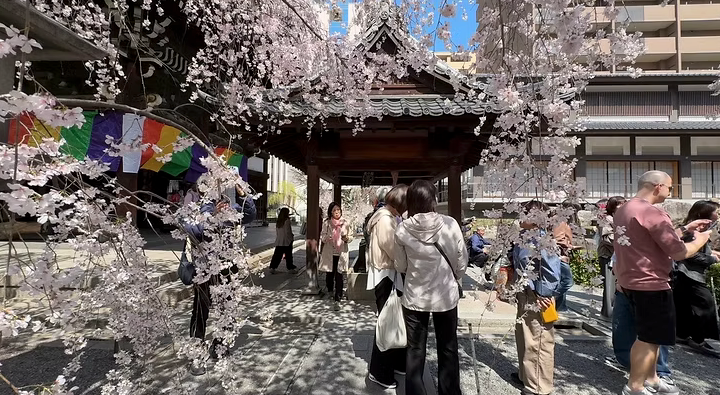
Rokkakudo Temple is very photogenic, and many tourists wearing kimonos visit it because they can take beautiful photos of the cherry blossoms.
This is a spot where you can enjoy cherry blossoms in the city, just a 7-minute walk from Nishiki Market.

Chōhō-ji (Rokkaku-dō) Temple
📍Location:〒604-8134 Kyoto, Nakagyo Ward, Donomaecho, 248
🌏Google Maps; https://maps.app.goo.gl/x6nM5DRpWbYbZsxq9
🔗Official website:http://www.ikenobo.jp/rokkakudo/
Kyoto Imperial Palace
The cherry blossoms at the Kyoto Imperial Palace (formally located within Kyoto Gyoen National Garden) are one of Kyoto’s most beloved spring attractions. Situated right in the heart of the city, this expansive national garden features around 1,000 cherry trees, offering visitors a long blooming season from mid-March through late April.

Main Highlights and Cherry Blossom Varieties
Weeping Cherries (Shidarezakura / Itozakura) at the Former Konoe Residence Site: In the northwestern part of the garden, about 60 graceful weeping cherry trees create a stunning early-season display. They typically reach full bloom from mid-March, making this one of the earliest cherry-viewing spots in Kyoto Gyoen. Their slender branches draped with delicate pink and white blossoms sway elegantly in the breeze. This area is also famous for a poem by Emperor Komei: “Mube mo karese nu itozakura kana” (Indeed, these thread-like cherry blossoms do not wither easily).

Area Around Demizu Stream (in the southwestern section): This scenic spot begins with weeping cherries, followed by wild mountain cherries (yamazakura) and Satozakura (including double-flowered varieties). In April, around ten different types bloom here, such as the rare greenish-yellow “Gyoiko” (御衣黄) and the vibrant “Kansan” (関山), offering a rich variety of colors and forms.
Sakon-no-Sakura (the Left Cherry): A classic yamazakura planted directly in front of the Shishinden (Ceremonial Hall) inside the Kyoto Imperial Palace. It forms part of the historic pairing known as “Sakon-no-Sakura and Ukon-no-Tachibana” (Cherry on the Left and Mandarin Orange on the Right), a tradition dating back to the Heian period. Originally a plum tree, it was later replaced by a cherry, adding to its fascinating history.
Other Notable Cherries: These include the Kurumagaeshi-zakura (near Seishomon Gate), famous for its mix of single and double flowers and the legend that Emperor Gomizuno-o turned his carriage back to admire it; mountain cherries at the former Gakushuin site; the “Sakura Matsu” (Cherry Pine); and many others. Throughout the garden, weeping cherries, mountain cherries, Ōshima cherries, and Satozakura bloom in succession, creating a beautiful, ever-changing landscape.
Kyoto Imperial Palace
📍Location: Kyotogyoen, Kamigyo Ward, Kyoto, 602-0811
🌏Google Map:https://maps.app.goo.gl/3S2XSfAZvtcPSGwB6
🔗Official website:
Kyoto Imperial Palace: https://kyoto-gosho.kunaicho.go.jp/en
Kyoto Gyoen National Garden: https://policies.env.go.jp/national-garden/kyotogyoen/
Maruyama Park
Maruyama Park (Maruyama Kōen) is Kyoto’s oldest public park, located in Higashiyama Ward. Adjacent to Yasaka Shrine, it is one of the city’s most famous cherry blossom viewing spots.

Centered around a traditional Japanese strolling garden, the park is dotted with elegant restaurants and teahouses. With approximately 650 to 680 cherry trees, it becomes lively in spring as many visitors come to enjoy hanami.
The park’s iconic centerpiece is a massive weeping cherry tree, widely known as the “Gion Night Cherry Blossoms,” offering beautiful scenery both day and night.

Main Highlights and Cherry Blossom Varieties
Gion Shidarezakura (Gion Weeping Cherry): This spectacular weeping cherry stands at the heart of the park. Its formal name is “Single White Higan Weeping Cherry.” The current second-generation tree is an impressive specimen, standing about 12 meters tall with branches spreading over 10 meters. Its gracefully drooping branches are covered in delicate pale pink blossoms, making it the undisputed symbol of Maruyama Park. It usually reaches peak bloom from late March, and the nighttime illumination creates an especially magical and ethereal atmosphere. This tree is famously associated with the “Gion Night Cherry Blossoms” celebrated in a poem by the renowned poet Yosano Akiko.
Somei-Yoshino and Other Cherry Varieties: The park features a large number of Somei-Yoshino cherries, along with mountain cherries (yamazakura) and double-flowered cherries (yaezakura). After the weeping cherry reaches its peak, the Somei-Yoshino trees bloom in full glory. The double-flowered varieties may continue to bloom until mid-April in some years. Strolling around the gourd-shaped pond (Hyōtan-ike) and through the winding paths of the Japanese garden allows visitors to enjoy a rich variety of cherry blossom expressions.

Maruyama Park
📍Location: Maruyamacho, Higashiyama Ward, Kyoto, 605-0071
🌏Google Map:https://maps.app.goo.gl/nZQZkHUJuDx3W6k26
🔗Official website:https://kyoto-maruyama-park.jp
📹Please also check out my YouTube videos!



コメント