
Nara Park & Todaiji Temple: Feeding Bowing Deer + World's Largest Bronze Buddha! (Japan Day Trip)
Nara Park and Todaiji Temple are hugely popular with tourists, but do you know about the special, fun experiences unique to this destination?
Feeding the deer with shika senbei (deer crackers), hiking up the beautiful green Mount Wakakusa, and crawling through the Great Buddha's nostril hole! 🦌🍘🌸
Nara Park is a vast park right in the center of Nara City, covering about 660 hectares (roughly the size of 140 Tokyo Domes!).

Its biggest highlight? More than 1,400 wild deer (as of 2025 data) roam freely here. The park is well-maintained as a tourist spot, and most areas are free to enter.
These deer are designated as a national natural monument and have long been revered as “messengers of the gods.” They're surprisingly tame and often approach people. You might even spot them crossing pedestrian crosswalks if you're lucky—something you won't see just anywhere!
The deer are tied to legends of Kasuga Taisha Shrine: a god is said to have arrived riding a white deer, which is why they've been protected for centuries. Harming them is strictly prohibited by law.
In the park, you can buy deer crackers (shika senbei, usually ¥150–200 per bundle) and feed the deer. Be careful—when there are lots of deer around, they can get competitive over food and swarm you!
The deer were so energetic that I stuck to feeding the fawns and does. Fun fact: these crackers are made from grass!

As soon as they spot the senbei, the deer come running, often bowing their heads or lowering them to beg. The trick to feeding them smoothly? Hand over one cracker at a time quickly, and when they're gone, spread both hands wide to show “all done!”
Never feed them anything else (like bread, snacks, etc.)—it's bad for them. Also, watch out: deer sometimes go after plastic bags, maps, or anything that looks interesting. Hold your belongings tight! Especially in spring (after fawning season) or autumn (rutting season), they can get a bit feistier. They might even sniff out senbei hidden in your bag.
The lush green mountain visible from Nara Park is Mount Wakakusa (Wakakusa-yama).

At about 342 meters high, it's covered entirely in unique grass unique to the mountain. The slope is steep, but the view from the top is breathtaking—you can see all of Nara City laid out below! A few deer hang out on the trails and summit, grazing or lounging. It's the perfect spot for photos with deer or just relaxing.

On the south side of Nara Park, full of adorable deer, you'll find Todaiji Temple. Todaiji was founded around 728 by Emperor Shomu during the Nara period as a massive temple to pray for national peace and the prosperity of Buddhism. It's part of the UNESCO World Heritage site “Historic Monuments of Ancient Nara.” Today, it serves as the head temple of the Kegon sect, while also incorporating elements of Shingon.

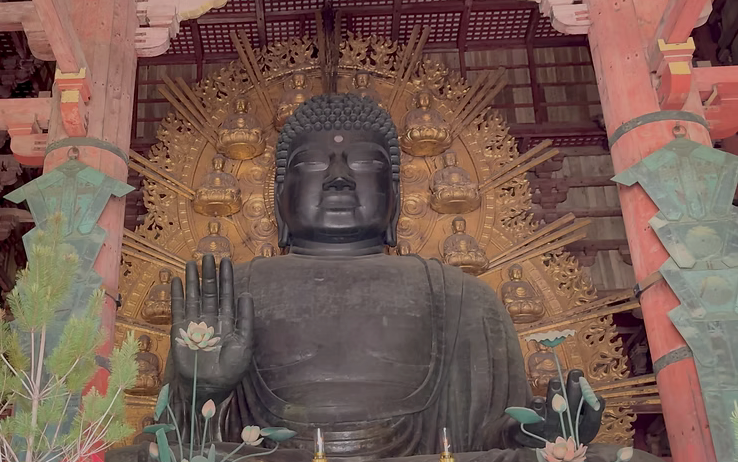
The star attraction is the Great Buddha (Rushana Buddha / Nara no Daibutsu) housed in the Daibutsuden Hall.
Standing about 14.98 meters tall (around 18 meters including the pedestal) and weighing roughly 250 tons, it's one of the world's largest bronze seated statues. The Daibutsuden itself is one of the largest wooden structures on Earth (57m wide, 50m deep, 48m high). Stepping inside, the sheer scale and power of the Buddha will overwhelm you. Surrounding it are statues like Nikko and Gakko Bodhisattvas, the Four Heavenly Kings, and more—creating a 3D mandala that embodies the world of the Kegon Sutra.
After circling the Buddha, near the northeast corner (the “demon gate” direction), there's a famous square hole at the base of one pillar—known as the Great Buddha's nostril hole.

The hole is roughly the same size as the Buddha's actual nostril: about 30cm wide × 37cm tall, with a depth matching the pillar's diameter (around 120cm). Crawling through is said to bring benefits like good health, wish fulfillment, and even improved intelligence or enlightenment! Kids slip through easily.
(The real architectural reason? It's likely to let evil spirits or bad energy escape from the demon-gate direction.)
I tried it myself—squeezing my shoulders, stretching one arm ahead—and barely made it! Super thrilling and exciting!

Nara Park and Todaiji blend historic temples with nature and animals in a truly special way. I recommend spending a full day wandering slowly. Access is easy: about 15 minutes on foot from Kintetsu Nara Station, or 10 minutes by bus from JR Nara Station. The scenery changes beautifully with the seasons—cherry blossoms in spring, colorful foliage in autumn, and peaceful quiet in winter.
On this Nara trip, I walked over 20,000 steps!
ーーーーーーーーーーーーーーーーーーーーーー
🦌 Nara Park 🦌
🌎 Google Maps: https://maps.app.goo.gl/zYJdmF8QArsvrK6B8
🔗 Official website: https://www3-pref-nara-jp.translate.goog/park/?_x_tr_sl=ja&_x_tr_tl=en&_x_tr_hl=en
ーーーーーーーーーーーーーーーーーーーーーー
🌸 Tōdaiji Temple 🌸
406-1 Zoshicho, Nara, 630-8587
🌎 Google Maps: https://maps.app.goo.gl/A3BSBEERTeX1mKS29
🔗 Official website: https://www.todaiji.or.jp/en/
ーーーーーーーーーーーーーーーーーーーーーー
⛰️ Mount Wakakusa ⛰️
Zoshicho, Nara, 630-8211
🌎 Google Maps: https://maps.app.goo.gl/Qde9RaiPUQRXff588
ーーーーーーーーーーーーーーーーーーーーーー
📹 My YouTube Video! Nara Travel 🦌🦌🦌


コメント